Modern intranet platform for Credit Agricole Bank Polska
CODEWAVE rebuilt the bank’s legacy intranet on a headless architecture with Flotiq, delivering 340% better performance, capacity for 100k daily pageviews and zero critical errors during Hypercare.

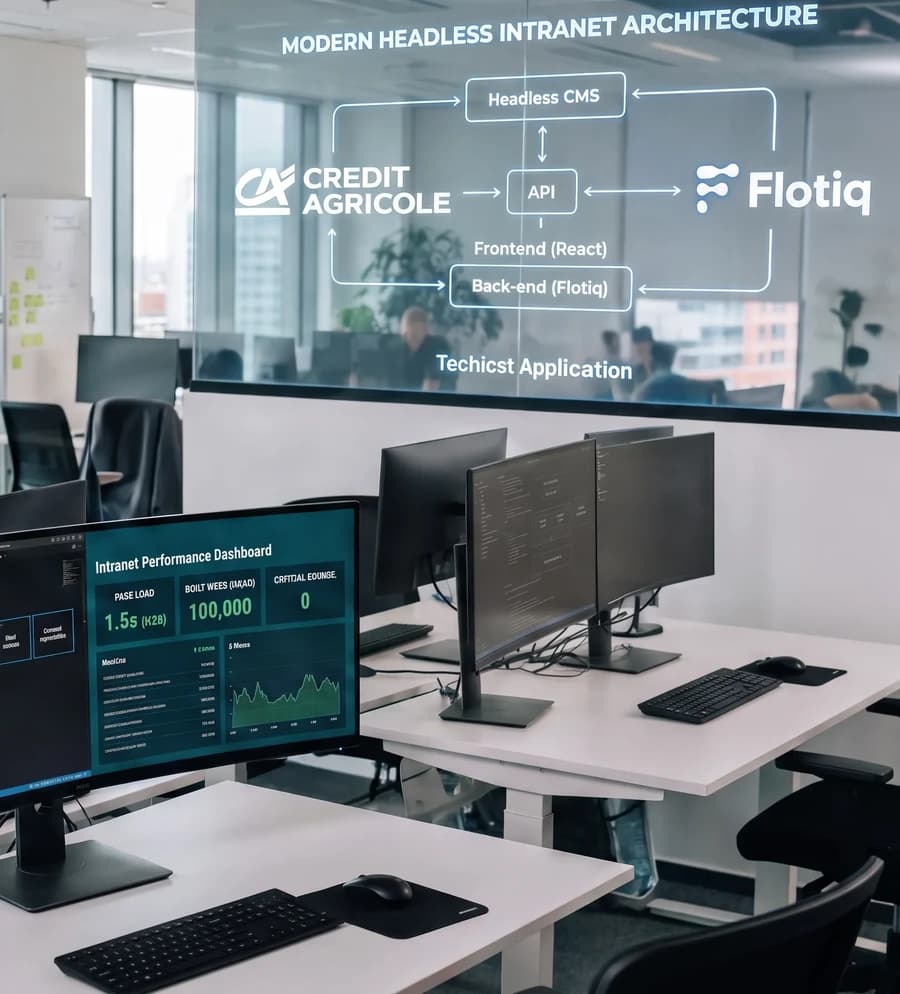
Credit Agricole replaced its legacy intranet setup with a headless architecture built on Flotiq. The new platform improved performance, handled peak traffic reliably and ran without critical errors during the measured period.
↑ 340%
Significant performance improvement - The site's responsiveness improved significantly, with the site being fully ready for user interactions in 1.5 seconds max.
100k
Enhanced user engagement - Peak handling capacity reached 100k pageviews in a single day, demonstrating the new system's robustness.
zero
Reduced error rates - The new system’s reliability is evident, with zero critical errors during the 4-week hypercare period.
About the client
Credit Agricole Bank Polska (CABP) is a modern, people-centred bank, employing 4200 people in Poland. The organization is a part of the Crédit Agricole Group. CABP transitioned from a WordPress-based intranet CMS to Flotiq Headless CMS. The migration reduced error rates, enhanced user experiences, and improved performance, with site responsiveness increasing by 340%. The reduction in critical errors underscores the dependability of the new system, and since adopting a Next.js-based application integrated with Flotiq, CABP has observed measurable improvements in system reliability and user experiences.

4 200
Company size

Banking/finance
Industry

Internal communications
About the project
Delivering timely and reliable information to customers is crucial, but the same applies to employees. While organisations worldwide recognise that their client-facing websites and applications must be high quality, the employee-facing side, particularly the intranet, is often overlooked. Credit Agricole Bank Polska saw an opportunity to improve its intranet. Its existing WordPress-based content management system (CMS) was still functional, but it faced challenges with performance, scalability and an inefficient update process. To address these challenges and remove bottlenecks, Credit Agricole Bank Polska decided to migrate to Flotiq Headless CMS. Due to the bank’s strict data security requirements, the team chose a dedicated, on-premise instance of Flotiq. This case study covers the migration, the challenges the team faced, the solutions CODEWAVE implemented and the results achieved.

At the time of the migration, a team at Credit Agricole Bank Polska was working on a solution that would seamlessly integrate their intranet data with other internal systems and applications. Thanks to the personalized API provided by Flotiq, the integration process was streamlined, allowing for efficient data retrieval and smooth connectivity with the client’s existing solutions. Since implementing Flotiq, Credit Agricole Bank Polska has increased user experience, streamlined content management processes, and enhanced online performance metrics. Read on to explore how a headless CMS can effectively support your company intranet.
"At the end of 2023 bank Credit Agricole effectively integrated the Flotiq Content Management System within its intranet. The platform offers a standardized method for accessing content and serves as the foundation for an all-encompassing intranet search engine that gathers information from various sources. Since the implementation, we have seen a significant improvement in performance metrics. Thanks to Flotiq’s scalability, we can enjoy our service accessed by a few thousands of employees without the risk of the system crashing."
The challenge
CABP encountered a number of challenges with their existing intranet content management system (CMS) that was based on WordPress. The key problems included poor performance measurements, such as high Time to First Byte (TTFB) of 3.5 seconds and a Time to Interact of 5.1 seconds. These metrics represent the most significant problems as they don’t meet the current standards.
Moreover, with the previous system, it was difficult for CABP to scale. When subject to peak loads, the system would often crash. The editorial and development teams found the process of system updates to consume too much of their time and work, with the uploading of new versions taking up to several weeks to complete successfully.
The issues that we were to address in our projects

Poor performance metrics
High Time to First Byte (TTFB) of 3.5 seconds and Time to Interact of 5.1 seconds - resulting in poor user experience. This meant that the page loaded for a long time (over 3 seconds).

Arduous update process
Updating the system took a long time and required much workload, with new version uploads taking up to several weeks to complete.

Scalability issues
The old system wasn’t scalable enough and occasionally experienced issues during peak loads.

Outdated design
The intranet needed some refreshing - both from the performance and design perspectives.
The solution
Credit Agricole Bank Polska chose to migrate to a dedicated solution that included Flotiq Headless CMS to allow for more flexibility, better performance, and ease of integration. To address the needs of CABP’s team, we created a tailor-made solution that would keep all the benefits of the previous CMS: like intuitive, easy use for content editors, and improve the metrics that didn’t meet the team’s requirements. Since Flotiq was created, as is being developed, by a team of passionate software engineers from CODEWAVE (Flotiq’s parent company), our team can easily build products that go beyond the tool’s standard offering and address custom needs of enterprise clients. To make sure the new intranet is easy to use, responsive, and efficient, the team has developed a web application based on Next.js - a React framework that supports static page development and server-side rendering.framework. By offering features that let developers create scalable and effective apps, it improves React's capabilities. Flotiq was a great addition to this tech stack as an out-of-the-box solution to provide flexibility and editorial ease of use.

The transition to the new app involved migrating existing content and optimizing web performance. The efficiency of our Next.js-based web app combined with Flotiq’s efficient caching mechanism translated into substantially lowered loading times. It made it possible to manage and deliver content more efficiently, which led to a quick and consistent user experience across all platforms. With just a few clicks, Flotiq's automated updating procedure was a game-changer and improved overall operating efficiency.
"Almost two years of direct and close cooperation with Crédit Agricole have shown me a well-managed, coordinated, and focused organisation. The team brings together people with remarkable creativity, a strong understanding of the bigger picture, and great business intelligence, all focused on designing a comprehensive strategy. The way the team asks the right questions leads to meaningful prototypes and great new features. This environment provides a strong foundation for long-term, dynamic cooperation that continues to develop and bring value to both parties."
What we achieved

Load time
700% improvement in TTFB - now 0.5s

Responsiveness
340% improvement in TTI - now 1.5s
Scalability
peak of 100k daily pageviews handled easily

The result
The migration was a huge task that involved moving a base of 30 thousand articles to the new platform. Though it might seem like a gruesome task, it was in fact automated to a large extent - and this type of automated migration is available for all large-scale projects transitioning to Flotiq. It’s worth mentioning that the results of this strategic move were quite impressive!
The Time to First Byte (TTFB) was reduced from 3.5 seconds to 0.5 seconds - which is a 700% improvement! That’s also a great results in terms of load time.
The Time to Interact dropped from 5.1 seconds to 1.5 seconds, a 340% improvement, boosting the site’s responsiveness.
The new system handled an unprecedented peak of 100k page views in a single day.
Feedback from end-users and the internal team was positive, highlighting the improved performance and user experience. Editors noted that they found Flotiq to be as simple as Wordpress for them to use, which was an important factor.
The conclusion
The migration to Flotiq enabled Credit Agricole Bank Polska to meet—and in some cases exceed—their expectations for their intranet system. Improved performance metrics, enhanced user experience, and streamlined content management processes have strengthened CABP's internal communication capabilities. This project underscores the importance of selecting a robust and flexible CMS to address the evolving demands of the digital landscape.